



For decades, the image of a successful STEM student in the UK was someone who could calculate complex derivatives in their head or recite logarithmic tables on command. In the traditional British tripos or A-Level examinations, “mental math” was the ultimate litmus test of academic prowess.
However, as we move further into the 2020s, the landscape of UK Higher Education (HE) has undergone a seismic shift. While numerical fluency remains a foundational skill, the rise of computational modeling, big data, and generative AI has turned mental arithmetic into a mere prerequisite rather than the finish line. Today, the “battle” of a degree is fought on the fields of critical analysis, software proficiency, and the ability to synthesize vast amounts of data into actionable insights.
The Shift from Calculation to Interpretation
In modern UK universities—from the Russell Group institutions to burgeoning technical hubs—the curriculum is moving away from “rote calculation.” According to the Higher Education Statistics Agency (HESA), there has been a 14% increase in enrollments for data-heavy courses like Data Science and Artificial Intelligence over the last three years.
In these environments, knowing that 15% of 450 is 67.5 is useful, but knowing why that percentage represents a statistically significant deviation in a clinical trial is what earns a First-Class Honours. The burden of performance has shifted from the “how” (calculation) to the “so what” (interpretation). This transition often leaves students overwhelmed, as they find themselves mastering the math but failing the methodology.
The Reality of the Modern Academic Workload
The UK education system is uniquely rigorous, characterized by independent study and high-stakes modular assessments. When a student is juggling advanced calculus, statistical software like SPSS or R, and the requirement to produce 5,000-word critical reports, mental math becomes the least of their worries. Many students find that they have the conceptual understanding but lack the time to execute their findings into the polished, academic format required by UK standards.
In such high-pressure environments, it is common to seek professional support to bridge the gap between raw data and academic excellence. For instance, many students choose to pay for assignments to ensure their complex mathematical findings are presented with the linguistic precision and structural integrity that British professors demand. This allows students to focus on mastering the core logic of their discipline without being penalized for the exhaustive time-sink of formatting and secondary research.
Why “Mental Math” Isn’t Enough: 3 Core Reasons
1. The Digitization of the UK Economy
The UK government’s Digital Strategy highlights that 92% of all jobs in the UK now require some level of digital capability. In higher education, this translates to “Computational Thinking.” It’s no longer about doing the sum; it’s about writing the algorithm that does the sum a million times over without error.
2. The Rise of Interdisciplinary Studies
Modern degrees are rarely “just math.” Economists need to understand sociology; engineers need to understand environmental ethics. Mental math cannot help you navigate the ethical implications of an automated bridge-building algorithm. You need high-level literacy and critical thinking—the “other half” of the battle.
3. Standards of Academic Rigour
UK universities maintain some of the highest academic standards globally. The Quality Assurance Agency (QAA) emphasizes “depth of autonomy.” This means students aren’t just tested on their ability to get the right answer, but on their ability to document the journey to that answer. If you need a hand navigating these complex requirements, seeking assignment help UK can provide the necessary scaffolding to understand how to present technical data in a scholarly manner.
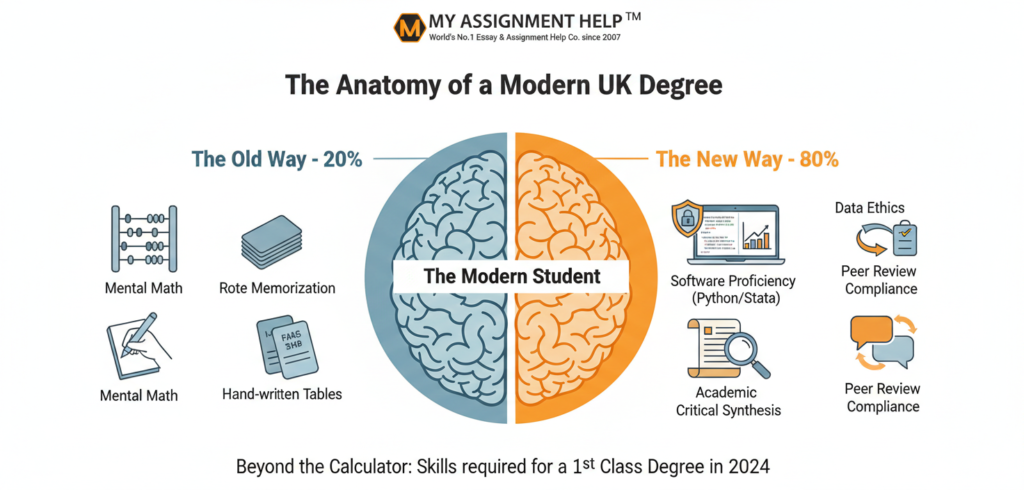
Data Points: The Skills Gap
| Skill Area | Importance in 1994 | Importance in 2024 |
| Mental Arithmetic | High | Moderate |
| Software Literacy | Low | Essential |
| Critical Synthesis | Moderate | High |
| Data Visualization | Low | High |
Source: Derived from UK Skills Survey & Department for Education (DfE) Industry Trends.
Navigating the “Other Half” of the Battle
If mental math is the engine, then academic writing and critical analysis are the steering wheel. Without them, the engine just runs in circles. To succeed in the UK Higher Education system, students must:
- Master the Tools: Move beyond the calculator. Learn Excel, Python, or LaTeX.
- Focus on the Narrative: Every data set tells a story. Your job is to be the storyteller.
- Seek Mentorship: Don’t struggle in silence. Whether it’s university office hours or external academic consultancy, getting a second pair of eyes on your work is vital.
Key Takeaways
- Calculation is a Commodity: Tools can calculate; only humans can contextualize.
- Software is King: Proficiency in industry-standard software is now mandatory in UK STEM and Social Science courses.
- Holistic Assessment: UK marks are heavily weighted toward “Critical Evaluation” rather than just “Correct Results.”
- Support Systems are Essential: Balancing technical math with high-level writing often requires external academic support.
Conclusion
The “Mental Math” era isn’t over, but it has been demoted. It is now the foundation upon which much more complex structures are built. To win the battle of modern UK Higher Education, you must be as comfortable with a keyboard and a critical essay as you are with a mental sum.
FAQ Section
Q1: Is mental math still tested in UK universities?
A: Yes, particularly in timed exams for Medicine, Pharmacy, and Engineering to ensure foundational safety and competence. However, it usually accounts for a small fraction of the total degree grade.
Q2: Why is academic writing so hard for math students?
A: Technical subjects focus on linear logic, while academic writing requires “discursive logic”—the ability to weigh different arguments. This shift in thinking styles is a common hurdle.
Q3: Is using academic help services like MyAssignmentHelp legal in the UK?
A: Yes, using such services for model answers, research assistance, and editing is a common practice to supplement learning, provided students use the work as a reference to improve their own understanding.
Author Profile: Dr. Alistair Vance
Senior Academic Consultant at MyAssignmentHelp
Dr. Alistair Vance is a former Senior Lecturer with over 15 years of experience in the UK Higher Education sector. Holding a PhD from the University of Manchester, he specializes in bridging the gap between quantitative analysis and qualitative reporting. Alistair now works with MyAssignmentHelp to provide students with the structural and analytical tools needed to excel in the rigorous UK academic landscape.